
How to make a watch
What it really takes to make your own watch — the parts, the design choices, the ways to build one for real, and how to prototype your design for free before you spend a cent.
In this guide
- What "making a watch" actually means
- The parts of a watch you'll choose
- Step 1: Decide what the watch is for
- Step 2: Choose the case shape, size and metal
- Step 3: Design the dial
- Step 4: Pick the hands
- Step 5: Choose the movement
- Step 6: Add complications (or don't)
- Step 7: Put your name on the dial
- Step 8: Build it for real (if you want to)
- Make a watch in Mecha Watch first
- Frequently asked questions
Say "Mecha Watch" quickly and you'll hear what we were thinking: make a watch. It's the thing almost every watch lover wants to do at some point. You look at enough dials and sooner or later you think, "I'd do it differently."
The good news: you don't need a Swiss workshop, a lathe or ten years of training. Making a watch is really three separate jobs — designing it, sourcing the parts and assembling them — and you can start the first one tonight. This guide walks through all three, in the order that saves you the most time and money.
What "making a watch" actually means
When people say they want to make a watch, they usually mean one of four things. Each takes a different amount of time, money and skill.
| Route | What you do | Skill needed | Rough cost |
|---|---|---|---|
| Design it | Choose every part and see the result before anything is built | None — just taste | Free |
| Assemble a kit | Buy a case, dial, hands and a ready-made movement, then put them together | Steady hands, a few tools | Low hundreds (USD) |
| Take a workshop | Strip and rebuild a movement under a watchmaker's supervision | None to start | A few hundred for a day course |
| Make it from scratch | Machine the plates, wheels and case yourself | Years of training | Thousands in tools |
Almost nobody makes every part from scratch — even most watch brands buy their movements, dials and hands from specialist suppliers. So "making a watch" usually means deciding what it should be, then putting the right parts together. The deciding part matters most, because that's what makes the watch yours.
The parts of a watch you'll choose
Every mechanical watch is built from the same few pieces. Knowing them is the first step, because every design choice you make is really a choice about one of these. (For the full anatomy, see our parts of a watch guide.)
- Case — the metal body. It sets the size, shape and character of the watch.
- Bezel — the ring around the crystal. Polished, fluted, a rotating dive scale, or set with stones.
- Dial — the face. Its colour and finish do more for the look than anything else.
- Indices — the hour markers: batons, Roman or Arabic numerals, dots.
- Hands — hour, minute and seconds. Dozens of classic shapes exist.
- Movement — the engine. Hand-wound or automatic, with its own beat rate and power reserve.
- Complications — anything beyond the time: date, moon phase, a second time zone.
- Strap or bracelet — easy to change, but it transforms the whole watch.
Step 1: Decide what the watch is for
Before you pick a single part, answer one question: when will I wear it? Watch styles grew out of jobs, and each job shaped the design.
- Dress watch — thin enough to slip under a shirt cuff, usually with a clean dial and a leather strap.
- Diver — a rotating bezel for timing dives, big luminous hands, a rubber strap or steel bracelet.
- Field watch — simple, legible, tough. Born in the trenches of the First World War.
- Pilot watch — a huge crown you can turn in flight gloves, and bold numerals.
You can break the rules — a gold diver or a field watch on a bracelet is completely fine — but starting from a purpose keeps the design coherent. More on this in watch case shapes.
Step 2: Choose the case shape, size and metal
Round is the default, but it's far from the only option. Tank, tonneau, cushion, octagon and oval cases each change the whole personality of the watch.
For size, most men's watches today fall between 38 and 42 mm; many women's watches sit between 28 and 36 mm. What matters more than the number is lug-to-lug length — the distance from the top of the watch to the bottom. If it overhangs your wrist, it's too big.
Then the metal. 316L steel is the workhorse. Titanium is about 40% lighter. 18k gold (75% pure gold) comes in yellow and rose, and black PVD is a hard coating only a few microns thick. See watch case materials for the trade-offs.
Step 3: Design the dial
The dial is where your watch gets its identity. Three decisions define it:
- Colour. Midnight blue, black, silver and cream are classic. Green, salmon and burgundy are having a moment.
- Finish. A sunburst catches light as you move; linen has a woven texture; enamel is glossy and deep; guilloché is engraved in patterns; fumé fades darker at the edges. Our dial finishes guide shows them all.
- Indices. Batons are modern and clean; Roman numerals are formal; Arabic numerals are sporty and legible. See indices and numerals.
Keep it simple the first time. The best dials usually have one idea, done well.
Step 4: Pick the hands
Hands are the most underrated part of a watch. Dauphine hands suit a dress watch; Mercedes hands say "diver"; Breguet hands, with their hollow moon tips, feel antique and elegant; syringe hands give a vintage pilot look. Match them to the case and dial — or mix them on purpose. Our guide to watch hand styles covers 18 of them.
Step 5: Choose the movement
This is the heart of the watch, and the biggest decision if you're building one for real.
- Hand-wound movements need you to turn the crown every day or two. Many people love that ritual — and without a rotor, the watch can be thinner.
- Automatic movements wind themselves as you move, using a swinging weight called a rotor.
Movements also differ in beat rate (how many times per second the seconds hand steps — 5, 6 or 8 are common) and power reserve (how long they run when fully wound — usually around 40 hours, sometimes eight days). If you're unsure, read automatic vs manual watches and how a mechanical watch works.
Step 6: Add complications (or don't)
A complication is any function beyond hours, minutes and seconds. The popular ones are a date window, a day-date, a small seconds subdial, a power reserve indicator, a moon phase and a GMT hand for a second time zone. Every complication adds clutter, so pick the one you'd actually look at. The complications guide explains each.
Step 7: Put your name on the dial
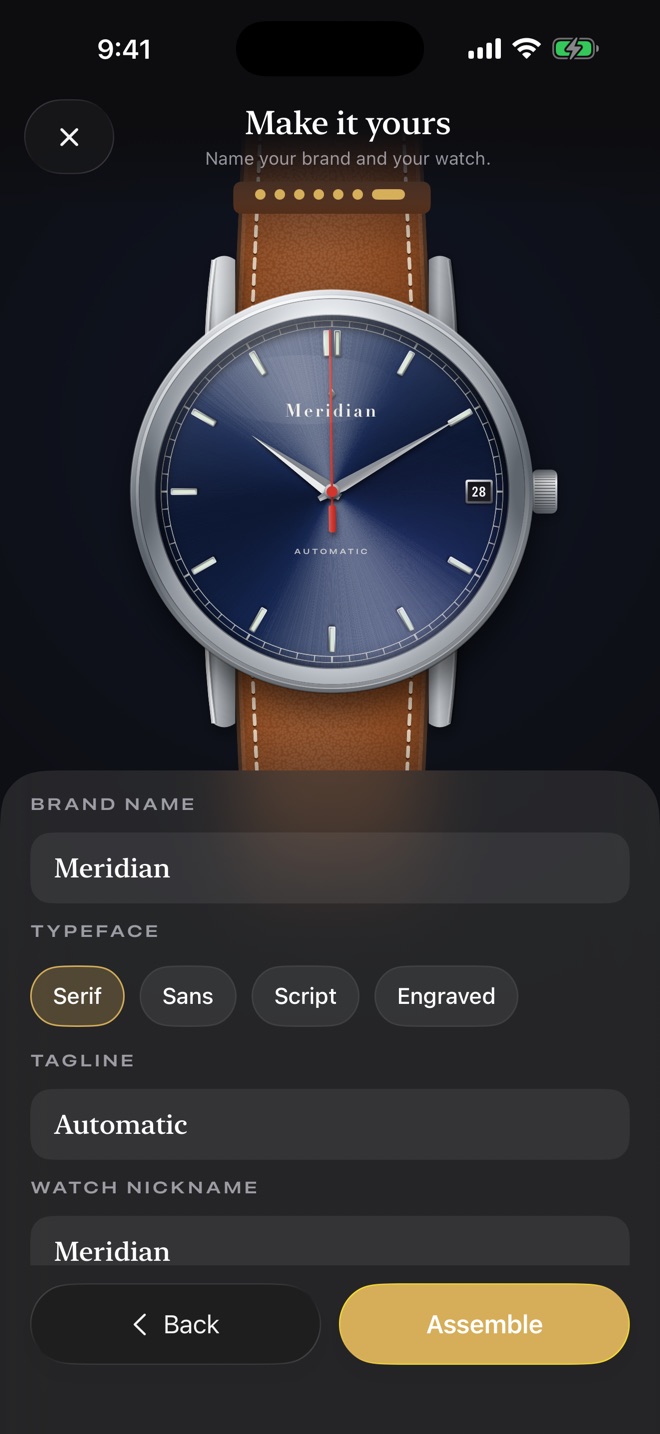
Most watch brands are named after their founders. There's no reason yours shouldn't be. A name at 12 o'clock and a short line at 6 — "Automatic", "Hand Wound", your initials, a date that matters — is what turns a set of parts into your watch.
Step 8: Build it for real (if you want to)
Once you know exactly what you want, you have three practical ways to hold it on your wrist:
- Assemble a kit or a mod. Hobbyist suppliers sell cases, dials, hands and reliable off-the-shelf automatic movements that fit together. Assembly needs a case knife, hand-setting tools, a dust-free surface and patience. Our build-your-own-watch guide covers what to buy.
- Take a watchmaking workshop. Many cities offer one-day courses where you strip and rebuild a real movement. It's the fastest way to understand what's happening inside.
- Commission a custom piece. Some small brands let you configure a watch and build it for you.
Whichever you choose, arrive with a finished design. Parts are cheap to buy and expensive to buy twice.
Make a watch in Mecha Watch first
This is why we built Mecha Watch. It's the design step and the fun part of owning a mechanical watch, on your iPhone:
- Choose from 11 case shapes, 5 metals, 6 dial finishes, 12 dial colours, 6 styles of indices and 18 hand styles.
- Pick one of four movements, each ticking at its real beat rate — 5, 6 or 8 beats a second.
- Add a date, day-date, small seconds, power reserve, moon phase or GMT.
- Put your own brand name and tagline on the dial, then watch it assemble.
Then it runs — and like a real mechanical watch, it needs you. Wind the crown and feel each click, or let your steps wind an automatic. Forget it, and it stops. It's the closest thing to owning a watch you designed, without buying a single part.
Mecha Watch. Make a watch. Say it fast — it's the same thing.
Frequently asked questions
Can I make my own watch at home?
Yes. Most home builders assemble a watch from a kit: a case, dial, hands and an off-the-shelf movement. You need a few inexpensive tools and a clean, dust-free desk. Making the movement itself from raw metal takes professional equipment and years of training.
How much does it cost to make a watch?
Designing one is free — in an app like Mecha Watch you can design as many as you like. Assembling a kit watch with a reliable automatic movement typically costs in the low hundreds of US dollars, plus tools. Custom-commissioned watches range from a few hundred to many thousands.
What is the easiest way to make a watch?
Design it first, then assemble a kit built around a ready-made movement. You don't touch the movement's internals; you only fit the dial, hands and movement into the case.
How long does it take to make a watch?
A design takes minutes. Assembling a kit takes an evening once you have the parts. Sourcing parts can take weeks, which is why it pays to finalise the design first.
Why is the app called Mecha Watch?
Because it's a mechanical watch you make yourself — and because "Mecha Watch", said quickly, sounds just like "make a watch".