
Watch case shapes, explained
A guide to watch case shapes — round dress, diver, field and pilot cases, plus tonneau, cushion, octagon, tank, oval and jewel — with history and sizing tips.
In this guide
The case is the first thing anyone sees on your wrist, and its shape sets the tone before they notice a single detail on the dial. A round case can be formal or rugged depending on how it's cut; a rectangular one instantly says "dress"; a barrel-shaped one says "I know what I'm doing."
If you're planning to make a watch, the case is the right place to start. Everything else — dial, hands, strap — has to fit inside and around it.
Round cases: one shape, four personalities
Round is by far the most common case shape — easy to machine, easy to seal, and it suits every dial. But round cases are cut very differently depending on what the watch is for. These four are the backbone of watch design.
Dress
Thin, polished, understated. Dress watches are slim so they slip under a shirt cuff, and many are hand-wound to save the height a rotor would add. Typical sizes run 36–40 mm, with short lugs and a thin bezel. Pair with a clean dial, slender hands and a leather strap.
Diver
Chunkier, with a rotating dive bezel, big luminous markers and a screw-down crown. The bezel only turns one way, so a knock can only make you think you have less air left, never more. Divers usually sit at 40–44 mm and look right on a rubber strap or steel bracelet.
Field
Plain, tough and legible. Field watches come from the trenches of the First World War, when soldiers swapped pocket watches for wrist straps. Expect a thin bezel, a matte case and a high-contrast dial, usually 36–40 mm.
Pilot
Large and bold, often 40–46 mm, with oversized "onion" crowns so they can be wound while wearing thick flight gloves. Pilot watches favour big Arabic numerals and a triangle at 12 o'clock so you can orient the dial at a glance.
Tonneau: the barrel
Tonneau means "barrel" in French. The case curves outward at the sides like a wine cask, with flatter ends at the top and bottom. Tonneau cases were fashionable in the early 20th century and have become a signature of avant-garde modern watchmaking, where they're often paired with sporty, open-worked dials.
A tonneau wears longer than a round watch of the same width, so check the lug-to-lug length before you choose a size. They look best with simple dials — the case is already doing the talking.
Cushion: square with soft corners
A cushion case is a square with generously rounded corners, like a pillow. It was popular in the 1930s and has come back through vintage-inspired divers. Cushion cases are tougher to water-proof than round ones, because the gasket has to follow a more complicated line.
Most cushion cases still hold a round dial, which creates a nice contrast between the soft-square outline and the circle inside. They wear larger than their measurements suggest because the corners fill out the wrist.
Octagon: eight flat facets
An octagonal case — or an octagonal bezel on a round case — reads as architectural and modern. It's also hard to make well: an eight-sided case is difficult to polish because every flat facet must meet its neighbours perfectly, with crisp edges. When it's done right, the alternating brushed and polished facets catch light in a way no round case can.
Octagon cases usually pair with integrated bracelets and sit at 36–40 mm.
Tank: the rectangle
The first rectangular Tank watch, from 1917, was inspired by the outline of tanks seen from above: the vertical side rails are the tracks, and the dial is the cabin between them. Rectangular watches have been the definition of dress-watch elegance ever since.
A tank case is measured by height rather than diameter. Around 28–34 mm tall works on most wrists. Roman numerals and blued sword hands are the classic pairing, and a leather strap completes the look.
Oval
Oval cases need an oval dial and specially shaped crystals, which is why they're rarer than round ones. They're softer and more jewellery-like than a tank, and sit comfortably on smaller wrists at 30–36 mm. They reward simple dials — a few indices, slender hands — so the outline stays the star.
Petite and jewel cases
Early wristwatches were considered women's jewellery; men carried pocket watches until the early 1900s. That tradition lives on in petite cases (28–34 mm) with delicate lugs, and in jewel cases with gem-set bezels. Each stone on a gem-set bezel is set by hand in its own seat and held with tiny beads of metal raised from the case.
How to choose a case size
Case diameter gets all the attention, but it isn't the whole story. Use these three numbers together:
| Measurement | What it tells you | Rule of thumb |
|---|---|---|
| Diameter (or height for non-round cases) | How big the watch looks from the front | 36–40 mm is the sweet spot for most men's wrists; 28–36 mm for most women's |
| Lug-to-lug | How long the watch sits on your wrist | Should be shorter than the flat top of your wrist — no overhang |
| Thickness | Whether it fits under a cuff | Under 10 mm feels dressy; divers often run 12–14 mm |
A quick test: measure your wrist with a strip of paper. Wrists around 15–16.5 cm usually suit 34–39 mm; 16.5–18 cm suit 38–42 mm; larger wrists can carry 42 mm and up. Shape matters too — tonneau and cushion cases wear larger than round ones of the same number, while tank and oval cases wear smaller.
Matching case shape to the rest of the watch
- Dress and tank cases: thin bezels, Roman or baton indices, Dauphine, Breguet or sword hands, leather straps.
- Diver cases: dive bezel, dots or batons with plenty of lume, Mercedes or plongeur hands, rubber or three-link bracelet.
- Pilot and field cases: Arabic numerals, syringe or pencil hands, leather or fabric straps.
- Cushion and octagon cases: textured dials like guilloché or linen, bracelets.
For materials — steel, titanium, gold, PVD — see watch case materials.
Try every case shape in Mecha Watch
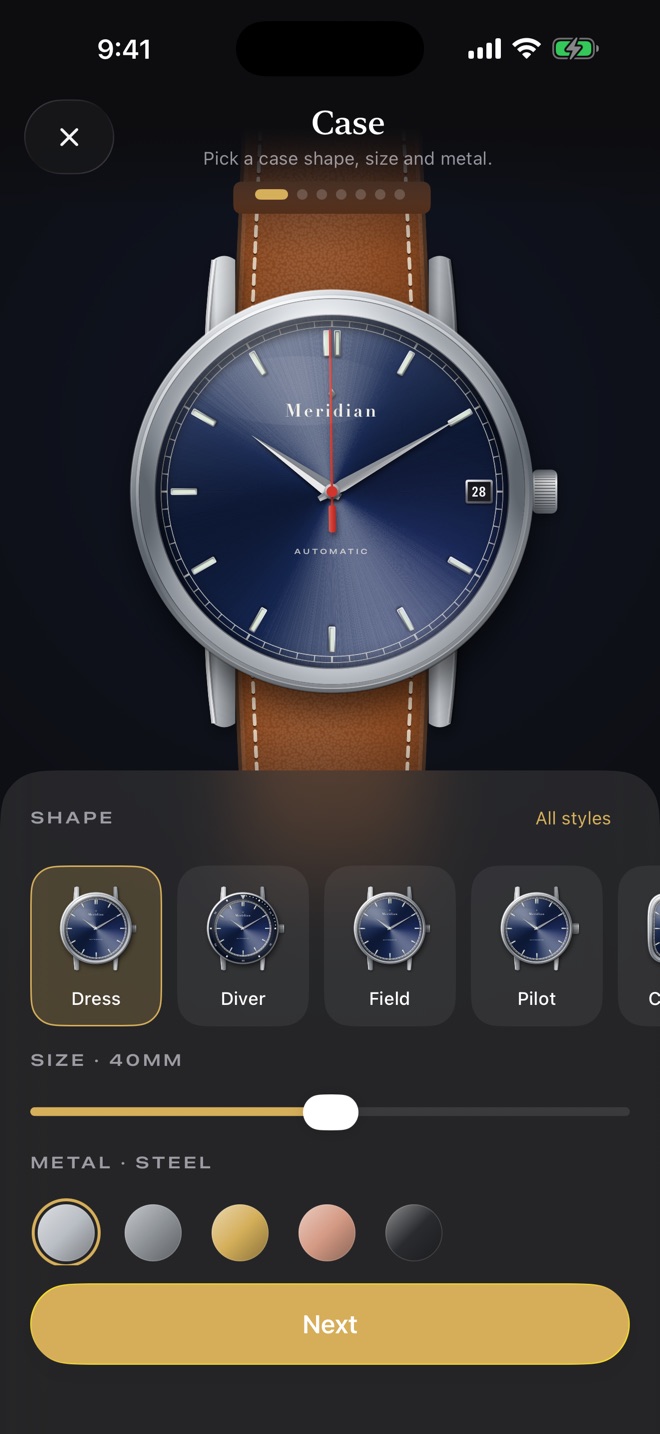
The easiest way to know which shape suits you is to see it built. In Mecha Watch you can choose from 11 cases — Dress, Diver, Field, Pilot, Tonneau, Cushion, Octagon, Petite, Oval, Tank and Jewel — each in its own size range, each with a crown sized to match and a fitting bezel to start from: big onion crowns on pilots, dive bezels on divers, gem-set bezels on jewel cases.
Pick a shape, dress it with a dial and hands, and watch it assemble and start ticking. Every case comes with a short "Did you know?" note on where it came from. It's the quickest way to go from "I like that shape" to a finished design — Mecha Watch, or as it sounds out loud, make a watch.
Frequently asked questions
What is the most common watch case shape?
Round. It's the easiest shape to machine and water-proof, and it suits every kind of dial, which is why dress, diver, field and pilot watches are almost all round.
What is a tonneau watch?
A tonneau watch has a barrel-shaped case: the sides curve outward like a wine cask and the top and bottom are flatter. "Tonneau" is French for barrel.
What is a cushion case watch?
A cushion case is square with softly rounded corners, like a pillow. It was popular in the 1930s and is common on vintage-style divers today.
Why is it called a Tank watch?
The first Tank watch, from 1917, was inspired by the outline of military tanks seen from above — the side rails echo the tracks.
What size watch case should I get?
For most men's wrists, 36–40 mm is a comfortable range; for most women's, 28–36 mm. The most important check is lug-to-lug length: the watch shouldn't overhang the top of your wrist.
Do square watches wear bigger than round ones?
Usually, yes. Cushion and tonneau cases fill more of the wrist than a round case of the same width, while tank and oval cases tend to wear smaller.