
Design your own watch
A practical, step-by-step guide to custom watch design — from purpose and proportions to dial, hands, movement and name — plus how to try every idea on your iPhone.
In this guide
- Start with a one-line brief
- Choose the case: shape, size, metal and bezel
- Design the dial: colour, finish and markers
- Match the hands to the dial
- Pick a movement that fits the story
- Add complications sparingly
- Finish with the strap and the name
- Check the design like a designer
- Design your own watch in Mecha Watch
- Frequently asked questions
Designing your own watch is the most satisfying part of watch collecting that most collectors never try. You don't need drawing skills or CAD software. You need a clear idea, a sense of proportion, and a way to see your choices together before you commit to them.
This guide is the design half of how to make a watch. It walks through the decisions in the order a designer would make them, with the rules of thumb that stop a custom watch from looking like a pile of parts.
Start with a one-line brief
Professional watch designers start with a brief, and yours can be one sentence. Try filling in this template:
A [style] watch for [occasion] that feels [mood].
"A dress watch for weddings that feels warm and old-fashioned." "A diver for everyday wear that feels tough but not bulky." "A pilot watch for travel that shows home time too." The brief doesn't limit you — it gives you a way to settle arguments with yourself later. When you're torn between two dials, pick the one that fits the sentence.
Choose the case: shape, size, metal and bezel
The case is the silhouette people see from across a room, so it comes first.
- Shape. Round cases are versatile. Tank (rectangular) and tonneau (barrel-shaped) cases read as elegant and a little unusual. Cushion and octagon cases feel sporty and architectural. Oval, petite and jewel-set cases lean dressy. Our case shapes guide explains where each came from.
- Size. Measure your wrist and be honest. A 38–40 mm round case suits most wrists; divers and pilot watches often run 42–44 mm; many smaller or dressier watches sit between 28 and 36 mm. The lugs should never overhang the edges of your wrist.
- Metal. Steel is neutral, titanium is light and slightly darker grey, yellow and rose gold add warmth, and black PVD makes almost anything look like a tool. See watch case materials.
- Bezel. A plain polished bezel lets the dial speak. A fluted bezel adds sparkle. A dive bezel adds function and bulk. A gem-set bezel turns the watch into jewelry.
Design the dial: colour, finish and markers
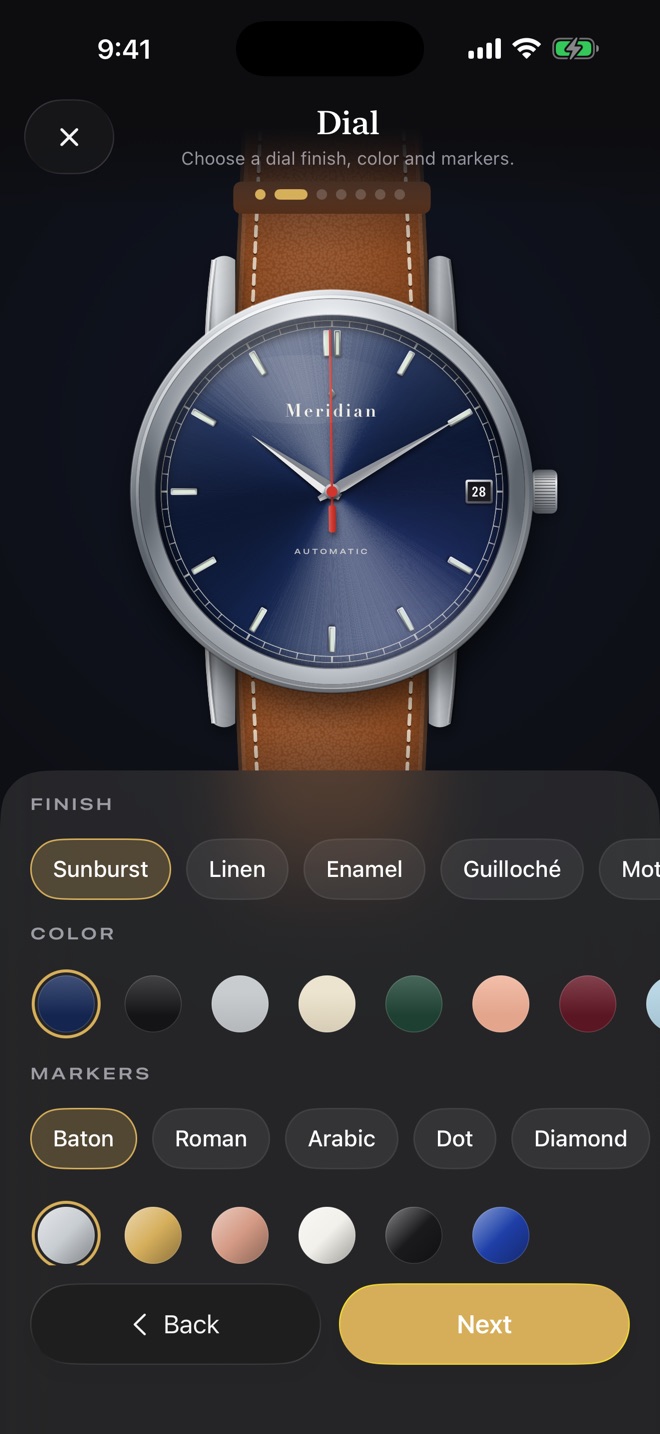
The dial is roughly 80% of how a watch "feels". Three layers stack on top of each other:
- Colour. Pick one main colour. Blue, black, silver and cream are safe classics; green, salmon, burgundy and ice blue give a design personality. If the case is gold, warm dials (cream, salmon, brown-toned blacks) usually look richer than cold ones.
- Finish. The texture changes the colour. A sunburst makes a flat blue flicker; a linen texture softens it; a fumé gradient makes it deeper at the edge. Compare them in our dial finishes guide.
- Indices and minute track. Batons, Roman numerals, Arabic numerals, dots, diamonds, or a California mix. A railway minute track adds a technical, vintage look; no track looks cleaner. More in indices and numerals.
Designer's rule: let one element be the star. A guilloché dial doesn't need Roman numerals, a jewel bezel and a moon phase. A plain dial can carry bold hands.
Match the hands to the dial
Hands are where many custom designs go wrong, because they're easy to overlook. Some pairings are classic for a reason:
| Watch style | Hands that fit | Why |
|---|---|---|
| Dress | Dauphine, Leaf, Breguet, Stick | Slim, faceted or elegant shapes that catch light without clutter |
| Diver | Mercedes, Plongeur, Sword | Big surfaces for lume, a minute hand you can't miss |
| Field | Pencil, Baton, Cathedral | Simple, sturdy and legible |
| Pilot | Syringe, Sword, Broad Arrow | Vintage aviation character, readable at a glance |
Then choose the finish — polished, blued, gold or black — and a seconds hand with an accent colour if you want one. A single red or orange seconds hand on an otherwise quiet dial is one of the oldest tricks in watch design. Browse all 18 shapes in our watch hand styles guide.
Pick a movement that fits the story
The movement decides how you live with the watch. A hand-wound movement asks you to turn the crown every day or two — ideal for a dress watch you wear with intention. An automatic winds itself as you move, which suits a daily watch. Beat rate changes how the seconds hand looks: 8 beats per second looks close to a glide, while 5 or 6 beats per second gives a visible, vintage step. If you're unsure, read automatic vs manual.
Add complications sparingly
Every complication fights for space on the dial. The date at 3 or 6 o'clock is the most useful. A small seconds subdial adds vintage charm. A power reserve gauge is handy on hand-wound watches. A moon phase is pure romance, and a GMT hand is a traveller's tool. One or two is usually plenty. See the complications guide for how each works.
Finish with the strap and the name
The strap can make or break the design. Leather dresses a watch up; rubber and three-link bracelets make it sporty; Milanese mesh and rounded links add a retro note. Try the same watch on two straps and you'll often see two different watches. Our straps and bracelets guide covers the main types.
Last, the name. Put a brand name at 12 o'clock — yours, a family name, something invented — and a short line at 6 such as "Automatic" or "Hand Wound". Typeface matters: serif feels classic, sans feels modern, script feels romantic, engraved feels formal.
Check the design like a designer
Before you call it done, run through this checklist:
- Squint test. Blur your eyes. Can you still read the time? If not, the hands and dial are too close in colour.
- Metal agreement. Hands and indices usually match the case metal (or are deliberately blued or black).
- One hero. Name the single element people will notice first. If you can't, simplify.
- Brief check. Re-read your one-line brief. Does the watch fit it?
- Live with it. Look at it again tomorrow. Designs that survive a night's sleep are usually good ones.
Design your own watch in Mecha Watch
Sketching on paper can't show you how a sunburst catches light or how Breguet hands look against a cream guilloché dial. That's the gap Mecha Watch fills: a watch designer app for iPhone where every choice appears on a real-time, metal-shaded watch as you make it.
- 11 case shapes, from Dress, Diver and Field to Tank, Tonneau, Octagon and Jewel
- Steel, titanium, yellow gold, rose gold and black PVD, with polished, thin, fluted, dive or gem-set bezels
- 12 dial colours in sunburst, linen, enamel, guilloché, mother-of-pearl and fumé
- 18 hand styles in four finishes, plus seconds hands and lume colours
- Four movements — Classic Hand-wound, Everyday Automatic, Vintage Slow-beat and 8-Day Manual — each ticking at its real rate
- Your own brand name, tagline and typeface on the dial
Short "Did you know?" notes explain each part as you choose it. When you're done, the watch assembles in front of you and starts ticking. Wind the crown, or walk for an automatic, and it keeps running. Share it with a QR code so a friend can build a copy.
The name says it: Mecha Watch — say it fast and you're telling yourself to make a watch. Designing your own is free to start.
Frequently asked questions
Can I design my own watch without drawing skills?
Yes. Custom watch design is mostly about choosing and combining parts — case, dial, hands, movement and strap. A watch designer app lets you see each combination instantly without drawing anything.
What is the best app to design your own watch?
It depends on your goal. Mecha Watch is built for designing a mechanical watch part by part and then keeping it running on iPhone and Apple Watch. Other tools focus on dial artwork for modders or on configurators that sell physical parts.
What size should my custom watch be?
Most people are comfortable with a 38–42 mm round case; smaller wrists and dress designs often suit 28–36 mm. Check the lug-to-lug length: the watch shouldn't overhang the edges of your wrist.
How do I make a watch design look professional?
Start from a clear purpose, keep one element as the star, match hands and indices to the case metal, and make sure the hands contrast with the dial so the time is readable at a glance.
Can I turn my digital design into a real watch?
Yes. Use it as a blueprint for a kit build or modded watch, or bring it to a custom watchmaker. See our guide to building your own watch.