
GMT watches explained: how to read a second time zone
What a GMT watch is, how the 24-hour hand and bezel work, the difference between "flyer" and "caller" GMTs, and how to set and read one when you travel.
In this guide
A GMT watch shows two time zones at once with one extra hand. It's one of the most useful complications there is — and one of the most misunderstood. Here's what the letters mean, how to read one, and what to look for if you want to make a watch with a GMT hand.
What does GMT mean?
GMT stands for Greenwich Mean Time, the time at the Royal Observatory in Greenwich, London, which was long the world's reference for time zones. Today the reference is UTC (Coordinated Universal Time), which for everyday purposes is the same thing. In watches, "GMT" has simply come to mean "shows a second time zone on a 24-hour scale".
How a GMT watch works
A GMT watch adds a fourth hand to the usual hour, minute and seconds hands. This GMT hand goes around the dial once every 24 hours instead of every 12. It points to a 24-hour scale, printed either on the dial's outer ring or on the bezel.
- The regular hour hand shows local time on the normal 12-hour scale.
- The GMT hand shows a second time — home time, or UTC — on the 24-hour scale.
- Both share the same minute hand, so this works for any time zones that differ by whole hours.
Because the GMT hand uses a 24-hour scale, it also tells you whether it's day or night in the other zone. 3 on the hour hand could be 3 a.m. or 3 p.m.; 15 on the GMT scale can only be 3 p.m.
How to read a GMT watch
- Read the local time from the hour and minute hands, as usual.
- Find the GMT hand — usually a different colour, often with an arrow tip.
- Read where it points on the 24-hour scale. That's the hour in your second zone; the minutes are the same as local.
With a rotating 24-hour bezel you can even track a third time zone: turn the bezel by the difference in hours, and read the GMT hand against the bezel instead of the dial.
"Flyer" GMT vs "caller" GMT
Not all GMT watches set the same way, and collectors care about the difference.
| Flyer (true) GMT | Caller (office) GMT | |
|---|---|---|
| What you adjust independently | The local hour hand | The GMT hand |
| Changing time zone | Jump the hour hand; the watch keeps running and the date follows | Reset the hour and minute hands, then move the GMT hand |
| Best for | People who travel often | People who stay put and call another time zone |
| Cost | Usually higher | Usually lower |
On a flyer GMT, when you land somewhere new you just jump the hour hand forward or back in one-hour steps. The GMT hand keeps showing home time and the date changes with the local hour. On a caller GMT, the GMT hand is what jumps, which is ideal if you mostly stay home and want to track a colleague overseas.
A short history of the GMT watch
The GMT watch as we know it was born in the 1950s, when jet airliners started crossing oceans and time zones in a single flight. Airline pilots and navigators needed to keep track of the reference time used for flight planning as well as local time at their destination. Watchmakers answered with a 24-hour hand and a two-colour bezel, often split into day and night halves. The formula has barely changed since, and the GMT became one of the classic tool watches alongside the diver and the chronograph.
Setting a GMT watch
Every movement differs, so check the manual, but a typical flyer GMT works like this:
- Pull the crown to the time-setting position and set the GMT hand and minutes to your home time (or UTC) on the 24-hour scale.
- Push the crown to the middle position and jump the hour hand to local time. The date moves with it.
- Push the crown back in (and screw it down, if it's a screw-down crown).
For general tips on crowns and hacking seconds, see how to set a mechanical watch.
GMT vs world timer vs dual time
- GMT: one extra 24-hour hand — two zones, or three with a rotating bezel.
- World timer: a rotating ring of city names shows the time in all 24 zones at once.
- Dual time: a separate 12-hour subdial for the second zone. Easier to read, but it takes up more dial space.
Designing a GMT watch
GMT hands work best on bold, legible designs: pilot and sports cases, black or dark dials, Arabic numerals and sword or syringe hands. Make the GMT hand a contrasting colour — orange, red or gold — so you never confuse it with the hour hand. See watch case shapes for the pilot case and its oversized crown.
Add a GMT hand in Mecha Watch
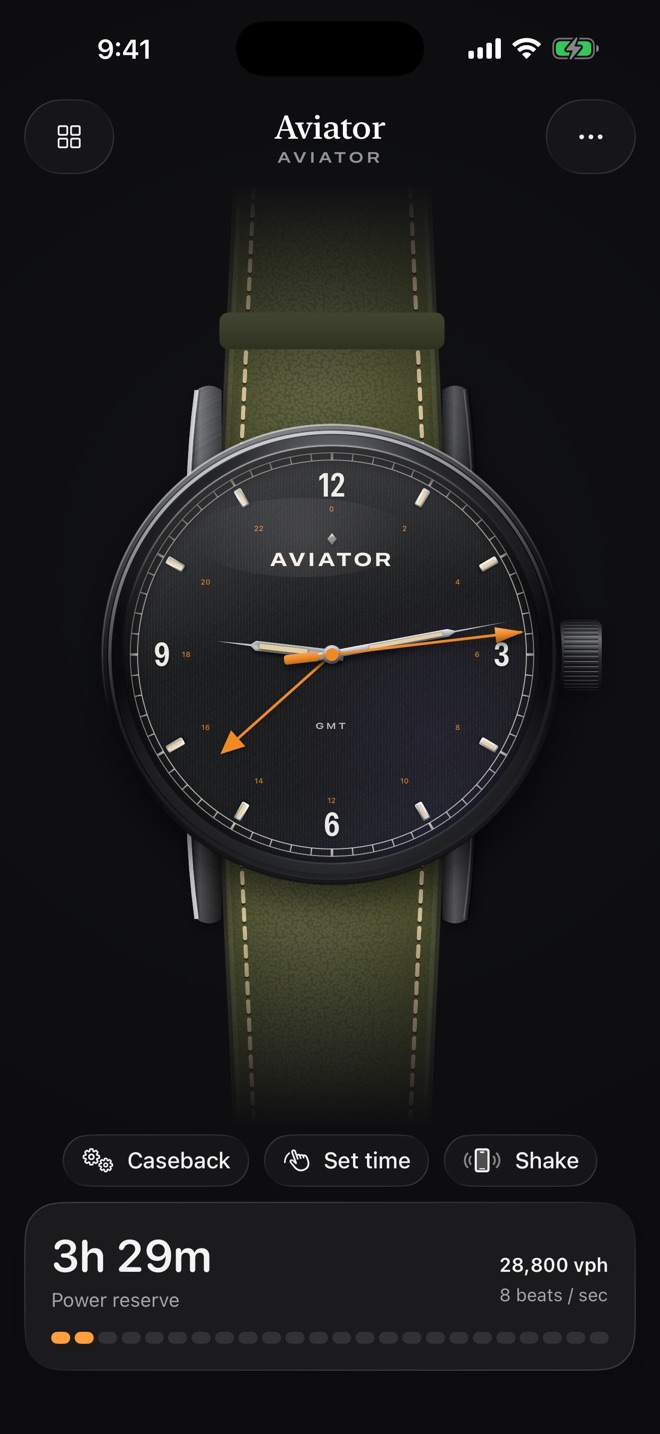
In Mecha Watch you can add a GMT complication to your design: a 24-hour hand plus a subtle 24-hour ring on the dial. The GMT hand is fixed to UTC, the modern equivalent of Greenwich Mean Time, so it's always a true reference — handy if you work with people around the world. It's part of the one-time Mecha Atelier unlock. One of the showcase watches, Aviator, is a black PVD pilot watch with syringe hands, an orange seconds hand and a GMT: a good place to start.
Mecha Watch sounds like make a watch. A GMT is a great first complication to make one with.
Frequently asked questions
What is a GMT watch?
A watch with an extra hand that rotates once every 24 hours, pointing to a 24-hour scale. It lets you read a second time zone — such as home time or UTC — alongside local time.
How do you read a GMT watch?
Read local time from the hour and minute hands as usual. Then read the GMT hand against the 24-hour scale on the dial or bezel to get the hour in the second time zone; the minutes are the same.
What is the difference between a flyer and caller GMT?
On a flyer (true) GMT, the local hour hand can be jumped independently — ideal for travellers. On a caller (office) GMT, the GMT hand is adjusted independently — ideal for people tracking another zone from home.
Can a GMT watch show three time zones?
Yes, if it has a rotating 24-hour bezel. Turn the bezel by the hour difference and read the GMT hand against it for a third zone.
Is GMT the same as UTC?
For everyday timekeeping, yes. UTC is the modern scientific standard; GMT is the older name, and it's still used for UK winter time.