
Watch power reserve, explained
Power reserve is how long a fully wound mechanical watch runs before it stops. Typical figures, how 8-day watches work, and what the dial indicator means.
In this guide
- What is power reserve?
- Typical power reserves
- How do you get more power reserve?
- The power reserve indicator
- Does timekeeping change as the reserve drops?
- Power reserve in automatic watches
- Power reserve vs battery life
- How to make the most of your reserve
- Watch your reserve drain in Mecha Watch
- Frequently asked questions
Wind a mechanical watch fully, put it on the table and walk away. At some point the seconds hand will slow down and stop. The time between those two moments is the watch's power reserve.
It's one of the most useful numbers in a watch's spec sheet, and it quietly shapes how you live with the watch. Here's what it means, what's normal and how to get the most from yours.
What is power reserve?
Power reserve is the length of time a mechanical watch runs on a fully wound mainspring. It's usually quoted in hours: "40-hour power reserve", "70 hours", "8 days".
The energy lives in the mainspring, coiled inside the barrel. As the watch runs, the spring unwinds and drives the gear train. When the spring has too little tension left to keep the balance wheel swinging, the watch stops. (If you'd like the full mechanism, see how a mechanical watch works.)
Typical power reserves
| Reserve | What it means in practice | Typical of |
|---|---|---|
| 38–42 hours | Wind daily; it survives one night off the wrist | Classic automatics and hand-wound movements |
| 48–60 hours | A comfortable margin; still running on Sunday morning | Many vintage and modern movements |
| 70–80 hours | Take it off Friday evening, still running Monday | Modern "weekend-proof" automatics |
| 8 days (≈192 hours) | Wind once a week | Long-reserve manual watches |
The "weekend-proof" idea explains why reserves have grown in recent years. A watch that survives from Friday night to Monday morning is much nicer to own than one you need to reset every Monday.
How do you get more power reserve?
Watchmakers have a few tools:
- A longer or thinner mainspring — more coils, more running time. Modern alloys help.
- Multiple barrels — two or more barrels in series act like one very long spring. Many 8-day watches work this way.
- A slower beat rate — a balance that swings less often uses less energy. That's one reason slow-beat movements can run longer. See beat rate explained.
- Less friction — better materials and escapements lose less energy per beat.
There's a trade-off. A longer reserve means more winding to fill it. An 8-day watch can take around a hundred turns of the crown from empty.
The power reserve indicator
A power reserve indicator — sometimes labelled réserve de marche or Auf/Ab ("up/down") — is a small hand or gauge on the dial that shows how much energy is left. It's one of the most practical complications: a fuel gauge for your watch.
Mechanically, it uses a small differential gear that compares two motions: the barrel being wound and the barrel running down. The difference tells it how much tension is left in the spring, and it moves the indicator hand accordingly.
Indicators are especially common on hand-wound watches, where they tell you exactly when to wind. They usually sit at 9 or 12 o'clock, as a small arc or a subdial.
Does timekeeping change as the reserve drops?
Often, yes. A fully wound spring delivers a fairly steady force, but as it approaches empty the force drops, the balance swings with less amplitude, and many watches start running a little fast or slow. That's why the advice is to wind at the same time each day: you keep the watch in the healthy middle of its reserve.
High-end watches use tricks like constant-force mechanisms to smooth this out, but daily winding does most of the job.
Power reserve in automatic watches
An automatic watch's reserve works slightly differently in daily life. While you wear it, the rotor keeps topping up the spring, so the reserve you actually carry depends on how active you are. A day of walking can fill it; a day at a desk may leave it half full. Take it off at night with a half-full spring and it may stop before morning, even though the spec sheet promises 40 hours.
That's why automatic owners are often surprised to find their watch stopped on a Saturday morning. Nothing is wrong — the rotor just didn't have enough motion to fill the barrel. A few turns of the crown each morning, or a longer-reserve movement, solves it.
Power reserve vs battery life
It's tempting to compare power reserve with a quartz watch's battery, but they're different ideas. A quartz battery lasts years and then needs replacing. A mechanical reserve lasts hours or days and is refilled by you, as often as you like, for the life of the watch. Nothing is used up; the spring is simply coiled and uncoiled, again and again.
That refill is part of the appeal. A mechanical watch with a short reserve isn't a worse watch — it's a watch that asks for a little more attention.
How to make the most of your reserve
- Hand-wound: wind fully once a day, ideally in the morning. See how to wind a mechanical watch.
- Automatic: if you've had it off, give it 20–40 turns before wearing. A desk-bound day may not keep it full.
- Rotating several watches: a long reserve lets a watch sit out a day or two without stopping.
- Don't worry about letting it stop. Running down does no harm.
Watch your reserve drain in Mecha Watch
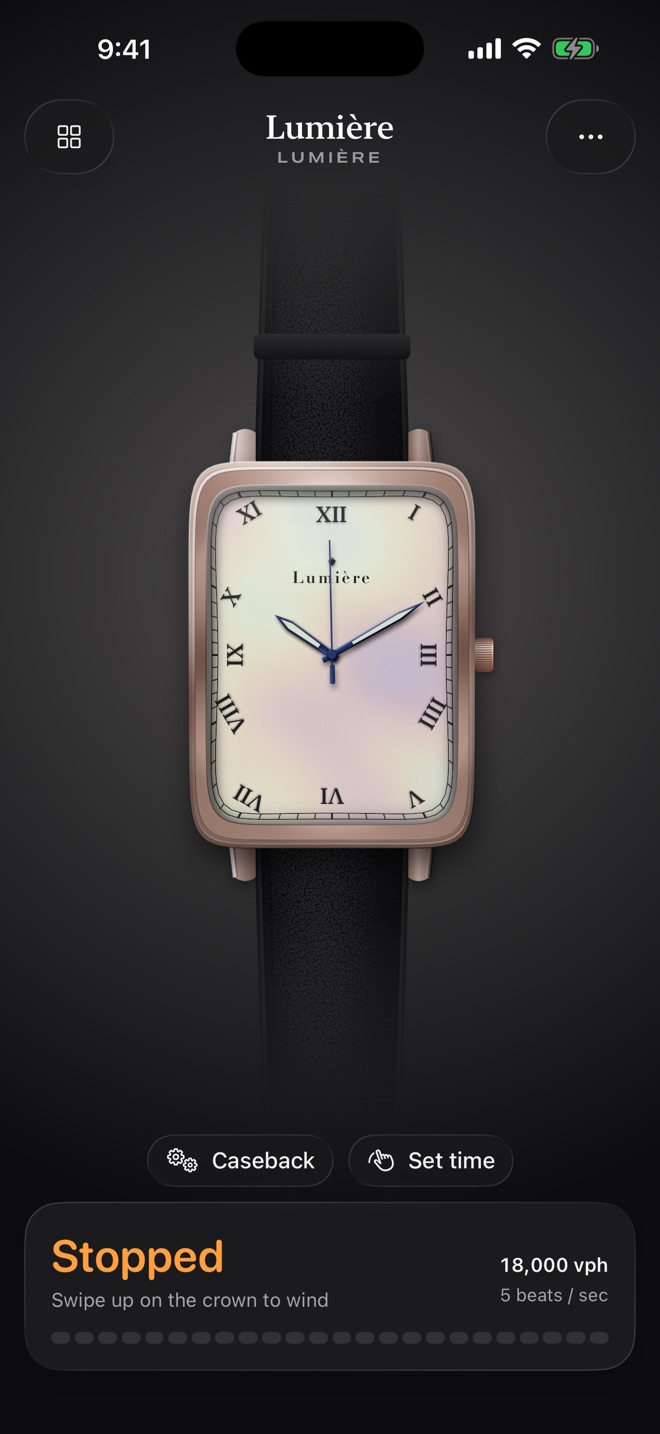
In Mecha Watch, power reserve isn't a spec sheet number — it's the thing keeping your watch alive. Each movement has a real reserve:
- Classic Hand-wound — 40 hours
- Everyday Automatic — 42 hours
- Vintage Slow-beat — 48 hours
- 8-Day Manual — 192 hours, and 110 crown turns to fill
Add the power reserve complication and a live gauge at 9 o'clock shows exactly how much is left. Wind the crown, or walk to power an automatic (1,000 steps is about three hours of reserve). Let it drain and the watch stops — with an optional reminder around two hours before. Mecha Watch: make a watch, then keep its reserve topped up.
Frequently asked questions
What does power reserve mean on a watch?
It's how long a mechanical watch keeps running from a full wind before it stops, usually quoted in hours.
What is a good power reserve for a watch?
Around 40 hours is standard. 70–80 hours is considered excellent for an automatic because it survives a weekend off the wrist.
Does an automatic watch have a power reserve?
Yes. While worn it stays topped up, but once you take it off it runs for its power reserve and then stops.
How does a power reserve indicator work?
A small differential gear compares how much the mainspring has been wound with how much it has run down, and moves a hand to show the difference.
How long will my watch run if I don't wear it?
For as long as its power reserve — typically 38 to 80 hours for modern watches, or up to eight days for long-reserve models.